Wellbeing tech / methodology · Case study
Designing for wellbeing, not engagement
Sweatty: a design system document at v4.0 and a draft ethical-design framework with eight principles, written down before the app was finished.
- Design system v4.0
- Ethical-design framework (draft, eight principles)
- Dark-patterns checklist
- Micro-interaction specification
- Quiet-hours notification rules
- 85+ colour tokens, light and dark
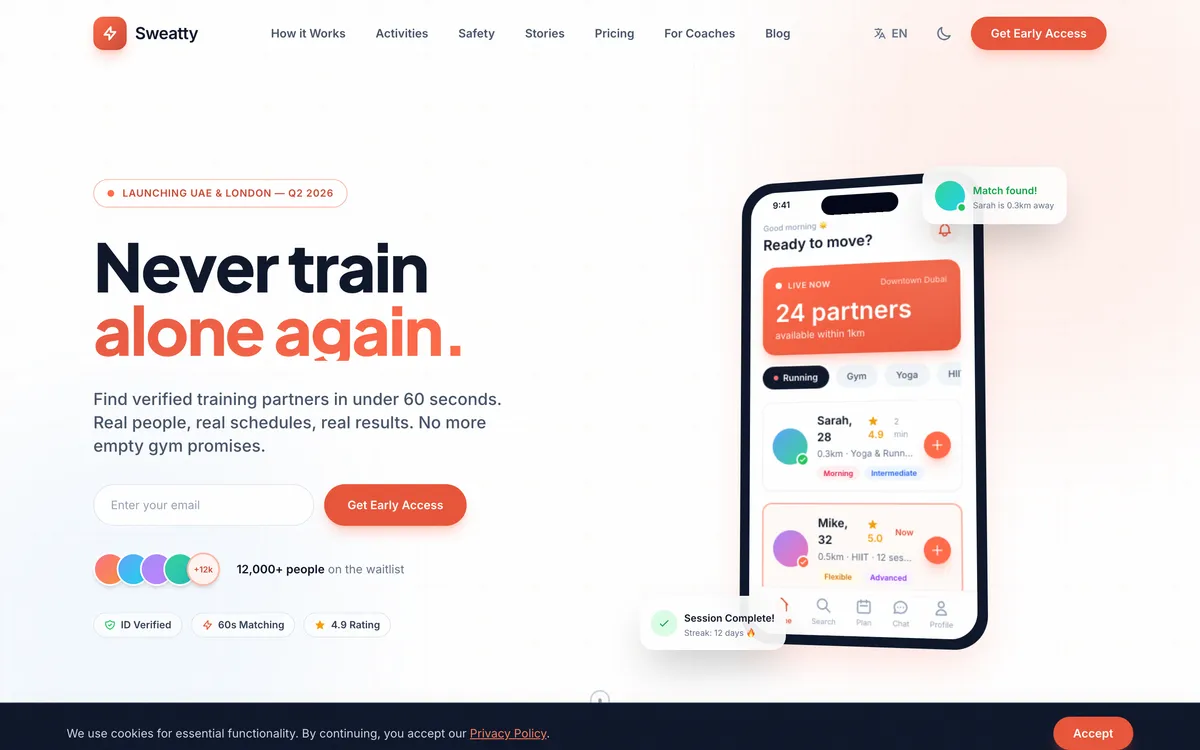
Sweatty is the methodology case study in this set, and it is deliberately different from the others. There is no growth-chart screenshot to point at, because the artefact is not a shipped consumer feature. The artefact is the discipline, written down: a design system document at version 4.0 and a draft ethical-design framework with eight principles for wellbeing technology, so that the product’s design starts from the person using it rather than from engagement.
Most case studies in this set answer “what does your code look like?” This one answers a harder question: what does your design discipline look like when nobody is watching?
Why methodology counts as a case study
Most case studies surface code and outcomes. This one surfaces a refusal, written down before anyone was under pressure to break it.
Sweatty’s brief is wellbeing tech: software whose stated purpose is to help people feel better, sleep better, move more, and be more present. The dominant pattern in that category is what we call dark wellbeing tech: apps that promise wellbeing while quietly monetising attention through streak shame, notification floods, social comparison, and reward loops tuned for retention rather than for the person using them.
Sweatty refused that pattern at the brief level, and the framework is where the refusal is written down. These are some of the things it rules out:
- Public leaderboards: progress is private by default, and sharing it is opt-in
- Streak shame: a missed day gets grace days, and the copy says rest is part of the journey
- Social features that are on by default: each one is opt-in
- Notifications at any hour: quiet hours are part of the design, with defaults for different kinds of user
- Marketing notifications without explicit opt-in
- Preselected options, and consent screens where declining is harder than accepting
- The standard dark patterns, from confirmshaming and false urgency to hidden costs and forced continuity, each on a checklist
The important move is that these are negative requirements, things the product must not do, and negative requirements are exactly the kind that erode under commercial pressure unless something enforces them. In Sweatty they are written rules, not yet constraints in code, and the gap shows in the build: the app still has a leaderboard screen and a streaks screen, on sample data, that the framework would change before launch. Writing the rules down is where enforcement starts. It is not the same thing as enforcement.
The artefact set: a system and a framework
Two source documents anchor the work, and they play different roles.
Sweatty Design System v4.0, dated March 2026, consolidates the earlier design documents, among them the revised design system, the wireframe specification, the micro-interaction system and the ethical-design framework, into one reference: more than 85 colour tokens for light and dark, 13 type styles across three platforms, more than 60 component variants with every state, and five design principles, starting with clarity first and trust through transparency. The version number counts revisions of that material, not years of use.
Document 22, Ethical Design & Wellbeing Safeguards, is the companion framework, still marked as a draft for review. Its eight principles run from wellbeing first and zero guilt to no exploitation, inclusive by design and grace always, and it turns them into specifics: a dark-patterns checklist, consent screens where declining is as prominent as accepting, quiet hours, private-by-default progress, and grace days so that a missed streak is not a failure. The questions the category argues about, such as when a streak helps and when social comparison turns corrosive, get a written default instead of a fresh argument each time.
The deliverable shape is portable. Many wellbeing-tech products could adopt the principle set wholesale, whatever UI framework they happen to run on.
What a written framework does, and what it does not
If you are designing for wellbeing seriously, you cannot get there in one pass. Each principle has to be tested against real product decisions, because every test surfaces edge cases the draft did not anticipate.
Sweatty has done the first half of that work: the rules are specific enough to check a build against, which most products never manage. The second half, turning them into constraints the code enforces, is still to do:
- Components. The framework names the patterns to avoid, but nothing in the component library stops a screen from using them yet.
- Notifications. Quiet hours are designed in, but nothing in the code caps how many notifications a day can send.
- Motion. The micro-interaction specification still includes celebration effects, such as a confetti burst for milestones, which a calm-by-default framework would need to bound. It does give every animation an instant fallback for people who reduce motion.
- Reasoning. Both documents record the reasoning behind their rules, not just the rules, which is the part that survives a change of team.
What VerySEOly imports from it
If you are building anything in the wellbeing or healthcare-adjacent space, a fitness studio booking site, a yoga teacher’s directory, a mental-health practice’s enquiry flow, the Sweatty methodology is the lens worth borrowing. It also feeds directly back into how we build.
Concrete things we carry across from the framework into client work:
- No streak-shame copy. Our pillar pages do not use “365 days of compliance” or “do not break your streak” framing to manufacture guilt.
- No social proof that implies other users are watching. An honest “as featured in” logo strip is fine; a fabricated “127 people booked this week” counter is not, and we will not build one.
- No dark patterns in the form flow. Contact, audit, and lead-magnet forms have a single primary action, no pre-checked consent boxes, no exit-intent “are you sure you want to leave?” dialogs, and no “limited time” countdown timers.
- Calm by default. Colour is saturated only where attention is genuinely warranted, and the same restraint carries through to the OG images we generate for articles.
If that kind of discipline is the work you want, particularly in wellbeing, mental health, fertility, paediatric care, or any sector where an engagement-optimised dark pattern would be ethically wrong, get in touch. Same accountable team, same pricing approach, same Sweatty-informed editorial discipline.
What this case study is not
It is not a story about a launched consumer product with growth charts. There is no monthly-active-user figure, no revenue number, no “we hit profitability in month six” milestone, and we are not going to invent one. The work sits upstream of all of that: a methodology written down before the product launched, in a design system at version 4.0 and a framework still in draft.
That is worth publishing because it answers the question a specification sheet cannot: what the rules were before anyone was under pressure to bend them. Anyone can promise they design ethically. The useful test is whether the rules are written down specifically enough to check a build against, and whether the gaps are named. Sweatty’s are, and the gaps are named above.